Table of Contents
In an era dominated by high-resolution tablets, stylus pens, and computer-aided design software, you might expect physical graph paper to be obsolete. Yet across university lecture halls, architectural studios, electronics labs, and home workshops, printable grid paper remains in high demand.
The reason is simple: printed grids offer instant, tactile, zero-latency utility. You do not need to wake a screen, worry about battery levels, or manage application updates when you want to calculate a formula, map a workshop cut, or brainstorm a room layout.
However, walking to an office supply store to purchase a pre-bound specialty pad of polar, isometric, or engineering paper is often impractical. Specialty stationery can be expensive, hard to find locally, and wasteful if you only need three or four sheets for a specific task.
Printable graph paper solves this problem. It allows anyone with a home or office printer to generate custom, purpose-built grid sheets on demand. Yet producing an accurate, usable printed grid requires understanding the distinct varieties of paper geometries, standard document formats, and the mechanics of accurate printer scaling.
A Comprehensive Guide to Grid Types
Selecting the correct grid pattern is the single most important decision when setting up a printable sheet. Different technical and creative disciplines rely on specific geometric arrangements to make recording information efficient.
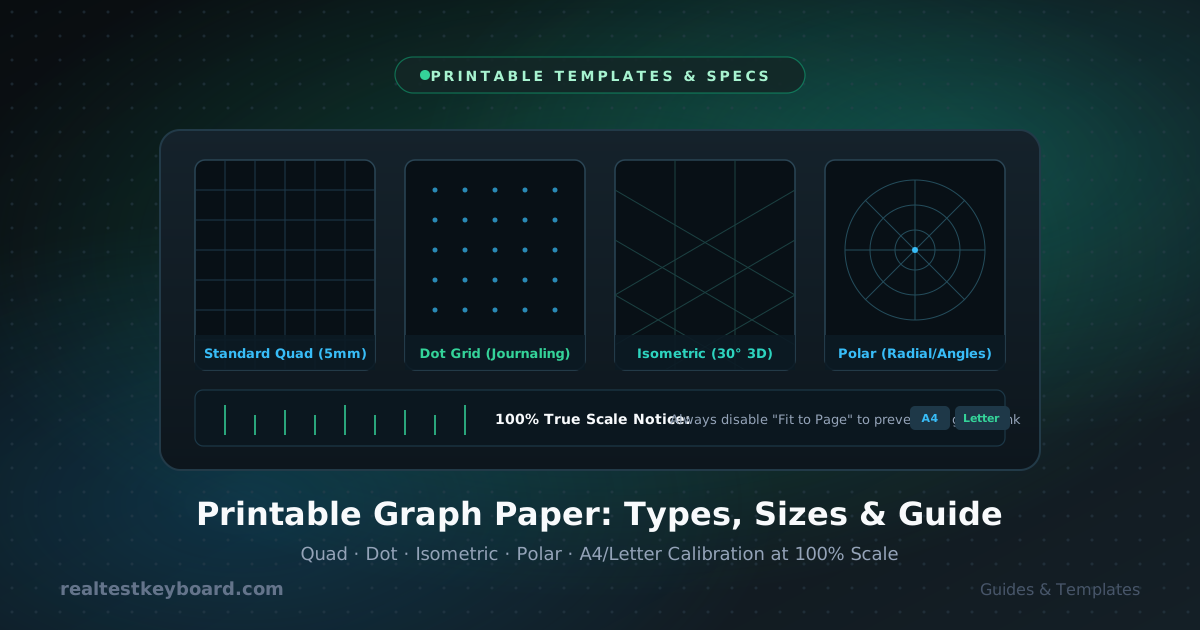
       Standard Quad                   Dot Grid                       Isometric
   ┌───┬───┬───┬───┐              •   •   •   •                  /\  /\  /\  /\
   ├───┼───┼───┼───┤                                            /  \/  \/  \/  \
   ├───┼───┼───┼───┤              •   •   •   •                 |  |   |   |   |
   ├───┼───┼───┼───┤                                            \  /\  /\  /\  /
   └───┴───┴───┴───┘              •   •   •   •                  \/  \/  \/  \/
(Algebra, Data, Layouts)     (Journals, Wireframing)           (3D Piping, Woodworking)
1. Standard Square / Quad Paper
The most recognized format, featuring uniform horizontal and vertical lines intersecting at right angles to create square cells.
- Common variants: 4 squares per inch (1/4“), 5 squares per inch, or metric 5mm grids.
- Primary uses: Secondary school mathematics, algebra calculations, simple bar charts, and general note-taking.
2. Dot Grid Paper
Instead of continuous solid lines, this style features subtle dots located exclusively at the coordinate intersections.
- Primary uses: Bullet journaling, creative lettering, and mobile/web UI wireframing.
- Key advantage: Offers structural guidance without the visual noise of dark intersecting lines, ensuring notes and sketches remain clean and prominent.
3. Millimeter and Engineering Grid Paper
Engineering paper features fine 1mm subdivisions with heavier, accentuated accent lines every 5mm or 10mm (1 centimeter). In imperial formats, it frequently presents 10 squares per inch with bolded inch demarcations.
- Primary uses: Physics lab data plotting, electronic circuit schematic drafting, and structural engineering sketches.
- Key advantage: Allows precise manual interpolation of continuous experimental curves and small-increment data points.
4. Coordinate / Cartesian Plane Grids
These sheets arrive pre-printed with bold, centered x and y coordinate axes, frequently divided into four numbered quadrants.
- Primary uses: Middle and high school math homework, vector problem sets, and geometry transformations.
- Key advantage: Saves students from spending valuable homework time ruling and calibrating axes manually with straightedges.
5. Isometric Paper
Constructed from a series of equilateral triangles formed by horizontal or vertical lines intersecting angled diagonals at 30° to the horizon.
         Isometric Axis Orientation
                 | (Vertical Height)
                 |
                 |
               /   \
(30° Width) / \ (30° Depth)- Primary uses: Three-dimensional mechanical visualization, piping layouts, furniture joinery plans, and technical concept art.
- Key advantage: Allows accurate 3D representations without vanishing-point perspective distortion; measurements along all three axes maintain identical scaling.
           Polar Grid                       Hexagonal Grid
             \  |  /                             _   _   _
           ---( O )---                          / \_/ \_/ \
             /  |  \                            \_/ \_/ \_/
     (Angle/Radial Plotting)               (Chemistry, Map Making)
6. Polar Graph Paper
Features concentric circles radiating from a central origin pole, intersected by straight radial lines indicating angular degrees (0° through 360°) or radians.
- Primary uses: Plotting polar equations (r, θ), acoustic dispersion maps, radio antenna radiation patterns, and navigational courses.
7. Hexagonal Grids
Consists of interlocking regular hexagons forming a honeycomb mosaic.
- Primary uses: Organic chemistry reaction diagrams (benzene rings), strategy board game map designs, and structural tiling simulations.
Paper Sizes and Formats: Global Standards Explained
Choosing the right paper size is critical for usability and legibility. Printing a complex engineering schematic on small paper creates cramped, illegible lines, while using oversized paper for simple notes wastes desk space.
   North American Formats                   ISO International Formats
 ┌───────────────────────────┐            ┌───────────────────────────┐
 │ Letter:  8.5 x 11.0 in   │            │ A3: 297 x 420 mm (Double) │
 │ Legal:   8.5 x 14.0 in   │            │ A4: 210 x 297 mm (Std)    │
 │ Tabloid: 11.0 x 17.0 in  │            │ A5: 148 x 210 mm (Half)   │
 └───────────────────────────┘            └───────────────────────────┘
North American Standards (Imperial)
- Letter (8.5 × 11.0 inches / 216 × 279 mm): The ubiquitous standard for offices and schools across the United States, Canada, and parts of Latin America. Ideal for day-to-day homework assignments and notebook binders.
- Legal (8.5 × 14.0 inches / 216 × 356 mm): Offers three inches of additional vertical room, making it popular for extended accounting tables, legal documentation, and elongated timeline schedules.
- Tabloid / Ledger (11.0 × 17.0 inches / 279 × 432 mm): The go-to imperial format for architectural floor drafts, landscape sketches, and large workshop diagrams.
ISO 216 Standards (Metric)
Used throughout Europe, Asia, Latin America, and Oceania, the ISO system relies on a consistent 1 : √2 aspect ratio. Folding an A-series sheet in half yields the next size down without changing proportions.
- A4 (210 × 297 mm / 8.3 × 11.7 inches): The international equivalent of Letter paper. The universal standard for academic coursework, technical manuals, and corporate reports worldwide.
- A3 (297 × 420 mm / 11.7 × 16.5 inches): Double the area of A4. Popular among engineers, draftsmen, and artists needing broad presentation space for detailed assembly drawings.
- A5 (148 × 210 mm / 5.8 × 8.3 inches): Half the size of A4. Frequently printed to create custom planner inserts, pocket journal refills, and compact bench-top cheat sheets.
The Critical Science of Printing at 100% Scale
A common frustration when downloading printable graph paper is discovering that a sheet labeled “1/4-inch squares” or “5mm grid” does not match a physical ruler. A five-square span intended to measure 25mm might measure 23.5mm instead.
This discrepancy rarely stems from the document design itself; it is almost always caused by automatic printer driver re-scaling.
                  Why "Fit to Page" Distorts Dimensions
 ┌─────────────────────────────────┐   ┌─────────────────────────────────┐
 │ Ideal Document (100% True Scale)│   │ Distorted Printout ("Fit to Page")│
 │                                 │   │                                 │
 │ ├─────1.00"─────┤               │   │ ├──0.94"──┤ (Compressed to fit  │
 │ [  1" Square   ]               │   │ [Squished ]  unprintable borders)│
 │                                 │   │                                 │
 └─────────────────────────────────┘   └─────────────────────────────────┘
Why Default Printer Settings Distort Your Grids
Most office printers cannot print edge-to-edge; they require a physical mechanical border (usually 3mm to 6mm) to feed paper through the rollers.
When you click “Print” in a standard browser or PDF viewer, the driver detects that the grid file extends close to the page edge. To prevent cutting off lines, the software automatically toggles on “Fit to Page”, “Fit to Printable Area”, or “Scale to Fit”.
This shrinks the entire document uniformly by 4% to 8%, reducing a precise 1.00-inch square to roughly 0.94 inches. For casual note-taking, this change might go unnoticed, but for scale modeling, woodworking cut lists, or precision data graphing, it renders the sheet unusable.
Step-by-Step Settings for True-Scale Printing
To guarantee that your printed graph paper matches real-world measurements:
- Open the Print Dialog: Access the native system print settings (avoid simplified mobile or web app print dialogs if dimensions are critical).
- Locate Page Sizing & Handling: Look for options titled “Page Scaling”, “Scale”, or “Paper Size”.
- Select “Actual Size” or Set Scale to Exactly 100%: Explicitly disable options like “Fit”, “Shrink Oversized Pages”, or “Scale to Fit”.
- Match Physical Paper to Document Target: Ensure your printer paper tray matches the target template (e.g., do not feed Letter paper when printing an A4 PDF).
- Verify with a Physical Ruler: Before printing 50 copies for a class or project, print a single test sheet. Place a calibrated ruler across 10 grid intervals to confirm the span measures exactly as expected.
Matching the Grid to the Task: Quick Selection Guide
| Application | Recommended Grid Type | Ideal Paper Format | Key Priority |
|---|---|---|---|
| High School Algebra & Pre-Calc | Coordinate (Cartesian) with pre-printed axes | Letter or A4 | Time savings and clean quadrant labeling |
| Laboratory Physics & Chemistry | Millimeter / Engineering (1mm minor, 10mm major) | Letter or A4 | High point-plotting resolution and clear data trends |
| Woodworking & Carpentry Plans | Isometric or 1/4“ Quad | Tabloid (11x17) or A3 | Space for cut dimensions and joinery details |
| Bullet Journaling & Routine Planning | Dot Grid (5mm spacing) | A5 or Letter/A4 trimmed | Low visual interference and versatile formatting |
| Circuit Design & Component Mockups | 0.1-inch Quad Grid | Letter or A4 | Matches standard breadboard pin spacing |
When to Print vs. When to Work Digitally
Printable graph paper bridges physical and digital workflows. While working on physical paper offers direct tactile engagement and freedom from screens, generating custom formats manually can be time-consuming.
Instead of hunting for expensive pre-printed specialty books that might sit half-empty, modern makers and educators often turn to customizable online platforms.
Using specialized printable graph paper and online grid tools makes it easy to experiment with custom grid dimensions, toggle coordinate axes on or off, test visual layouts, and produce calibrated PDFs optimized for clean, true-scale printing.
Whether you need a single sheet of polar paper to map an antenna array, an isometric grid to plan a home renovation project, or regular quad pads for classroom assignments, printing on demand gives you the exact layout you need, whenever you need it.
Test every key directly in your browser
Detect stuck keys, key chatter, input latency, and full rollover with our instant, zero-download diagnostic tool.
Start Keyboard Test →